

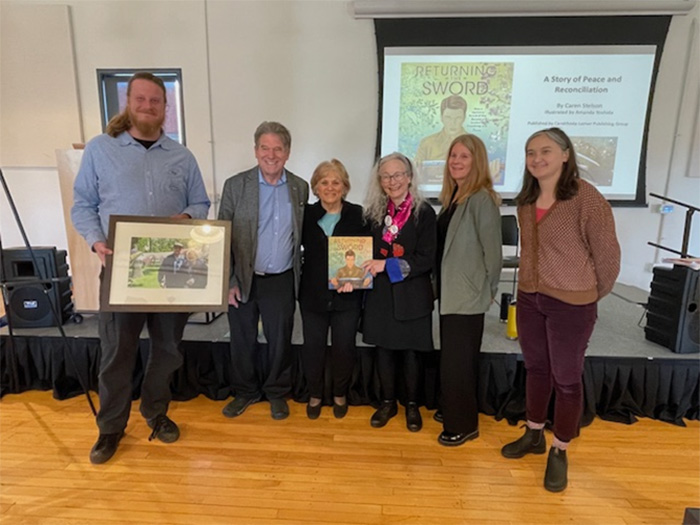
The afternoon at Fort Snelling still reverberates through me. Between 50–60 people came together at Fort Snelling on Saturday, April 18, to share the story of Returning the Sword. A collective expectancy filled the room. I wondered if we came for this WWII story with the Iran War on our minds. We all had watched the senseless bombings on our screens. The maiming. The killing. We heard or read about the bloodthirsty tweets from Trump and Hegseth. News of the day had made Orval’s WWII sword story all the more relevant.
I deliberately opened my presentation, connecting Trump’s recent Easter Day wartime threat to destroy the Iranian civilization with Orval’s real-life experience stepping into the remains of Nagasaki after nuclear war. I spoke about Sachiko Yasui, the six-year-old I had written about who miraculously survived the atomic bombing of her city on August 9, 1945 and her long path to peace— about searching for a WWII veteran who had been first into Nagasaki as part of the U.S. occupying force—about finding Captain Orval Amdahl’s WWII oral history in the Minnesota History Center, and the convergence of events that led me to meet Orval and his sword.
With that background, the audience was ready to listen to the actual picture book reading of Returning the Sword. Picture books, I said, are for everyone. I could have ended the event at the last page, but we all knew there was so much more to talk about. My five guest panelists, Lori and Jacob Harrington, Kimmy Tanaka, Amy Blumenshine, and Mark Ritchie individually and collectively took Orval’s story to a deeper level.
Jacob Harrington, Orval’s great-grandson, shared his childhood memories hiding in the closet with the sword as a six-year-old playing hide-and-seek and then as a middle schooler interviewing his great-grandfather for History Day. Jacob’s History Day project is the reason Orval’s WWII story is in the MN History Center’s “Greatest Generation” library.
Jacob’s mother Lori recounted that the story of Orval’s returning the sword has found its way to the U.S. Marine Corp and is now part of its lore.
Kimmy Tanaka spoke of the importance of cross-cultural connections that lead to lasting ties of friendship and peace. She knows how true this is. Kimmy herself is a child of a cross-cultural marriage.
Amy Blumenshine, a scholar of moral injury, took us further into war’s deep wounds and the healing and reconciling that must come if veterans are truly to survive their war experience. War does not end at war’s end. Soldiers may take off their uniforms, but they still harbor the moral injury to their conscience when commanded to kill and destroy or witness the unimaginable. Given the fighting in the Pacific during WWII and the witnessing of the destruction of Nagasaki after the atomic bomb, Orval’s polishing the sword may have been his way of silently healing from his own moral injuries.
Lastly, former MN Secretary of State Mark Ritchie spoke of other veteran stories he knew that paralleled Orval’s. The cruel experiences in soldiers’ lives can cripple them for life, even if they return home able-bodied. Mark’s remarks and civic service brought a gravitas to all that was said that afternoon.
At the end of our time together, I presented Jacob Harrington with a large framed photo of Orval and Marie Amdahl, his great-grandparents. Years ago, when I first started writing about Orval and his sword, I bought this photo at an art gallery in the Amdahl’s hometown of Lanesboro. Jacob’s father Jeff Harrington, had been the photographer. I loved the photo, but that Saturday morning at home, I kept staring at it. The photo wasn’t really mine. It belonged to Jake. In the spirit of the sword’s return, I needed to give the photo to him.
The following day, I received an email from Mark Ritchie: Yesterday was super important — you have planted seeds deep and these will become trees and then a forest, I do believe. I’m not sure of Mark’s prophecy, but I do know that Saturday afternoon each of us walked away with seeds that remind us of war’s ever-lasting toll and the reason peace, no matter how hard to achieve, is the seed we must plant.
###